The History of Murder Mystery Games
Murder mystery games feel like a modern invention — scripted dinner parties, escape-room whodunits, streaming social deduction apps. In reality, the idea of gathering a group of people, handing them secrets, and asking them to lie, deduce and accuse one another is over 150 years old. Here's how we got from Victorian drawing rooms to Discord servers.
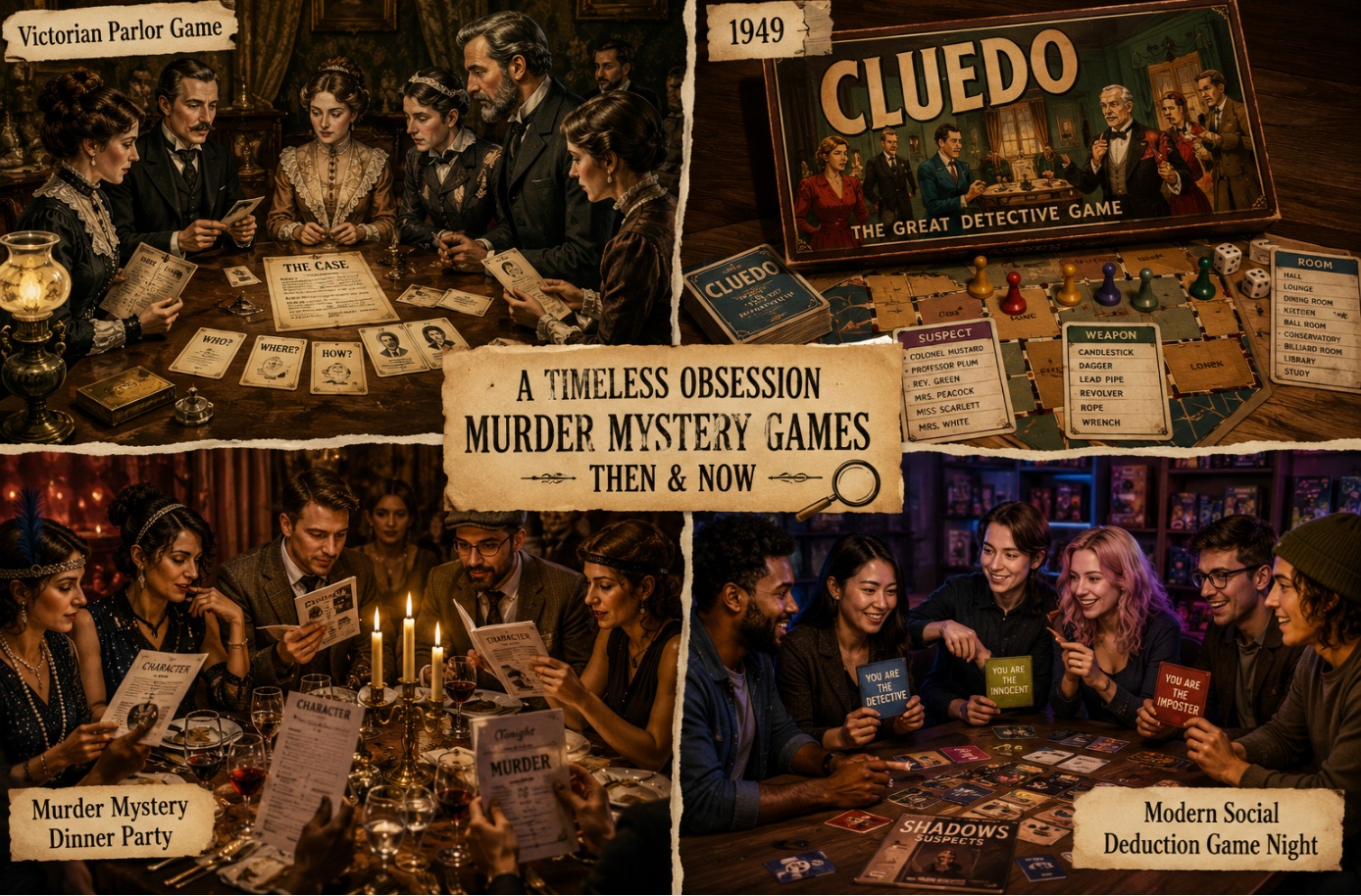
It Starts With the Parlor Game (1800s)
Long before anyone printed a "murder mystery kit," the 19th-century upper and middle classes filled long evenings with structured social games designed to do exactly what a modern murder mystery does: assign roles, hide information, and force conversation. Games like "Twenty Questions," "The Minister's Cat," and charades trained an entire culture in the basic mechanics that murder mystery games still use — deduction through indirect questioning, performance, and reading other people's reactions. These games didn't involve a "murder" yet, but they proved that a party built entirely around a shared fiction and hidden information could be genuinely thrilling.
The Birth of the Whodunit (1841–1930s)
In parallel, detective fiction was inventing the actual grammar of the murder mystery. Edgar Allan Poe's 1841 short story "The Murders in the Rue Morgue" is widely credited as the first true detective story, introducing the amateur sleuth who out-reasons the police. By the 1920s and 30s — the so-called Golden Age of detective fiction — writers like Agatha Christie, Dorothy L. Sayers and S.S. Van Dine had codified the "fair play" whodunit: a closed circle of suspects, a detective, a set of clues the reader could theoretically solve alongside the sleuth, and a satisfying reveal. This structure is the direct ancestor of every murder mystery party script and escape-room case file written since.
Cluedo Puts a Whodunit in a Box (1944–1949)
During WWII air-raid blackouts in England, when families sheltered indoors for hours at a time, a Birmingham factory worker named Anthony E. Pratt designed a board game that let players physically move through a mansion, gathering evidence about a murder. Pratt and his wife patented "Murder!" in 1944; Waddingtons in the UK refined and released it in 1949 as Cluedo, while Parker Brothers launched the same game in the US as Clue. It became one of the best-selling board games of the 20th century and, for millions of people, their very first "murder mystery game." Read the full story on our Clue & Cluedo page.
The Dinner Party Era (1970s–1980s)
Board games told you the murderer was Colonel Mustard. But in the 1970s, a new format emerged in the US and UK: the scripted murder mystery dinner party. Hosts would buy (or later, download) a boxed kit containing character dossiers, secret motives and a killer known only to one player. Guests dressed as their characters, improvised conversation over dinner, and pieced together the crime course by course. This format — the direct ancestor of the kits sold today by sites like Murder Mystery Host — turned "murder mystery" from something you read or rolled dice for into something you performed with friends.
Mafia Brings It to the Circle (1986)
At almost the same time, an entirely different lineage was developing in the Soviet Union. In 1986, psychology student Dmitry Davidoff created a party game at Moscow State University to demonstrate group psychology to his classmates: a moderator secretly assigns "Mafia" and "civilian" roles, and the group must debate and vote out the hidden killers before they're eliminated one by one. No script, no props, no board — just people, secrets and suspicion. Under the names Mafia and later Werewolf, this format spread through student groups worldwide and became the foundation of modern social deduction games. Full story on our Mafia & Werewolf page.
Live Events, Escape Rooms & Immersive Theatre (1990s–2010s)
Murder mystery dinner theatre companies professionalized the format through the 90s and 2000s, staging ticketed events in restaurants and hotels with hired actors playing suspects among the paying guests. The 2010s escape-room boom borrowed the same DNA — locked-room puzzle-solving under time pressure — and immersive theatre productions blurred the line between audience and cast even further, proving that people were hungry for mystery experiences that went beyond sitting and reading.
The Social Deduction Boom (2010s–Today)
Mafia's DNA resurfaced in a wave of modern hits: The Resistance and Avalon (hidden-team deduction), Werewolf apps for parties, and 2018's Among Us, which became a global phenomenon in 2020 by putting Mafia's core loop into a video game. On the tabletop side, 2022's Blood on the Clocktower took social deduction to its most sophisticated form yet, with a "Storyteller" running an asymmetric, evolving mystery for a full table of players. Meanwhile, streaming television (see our TV series guide) brought whodunit storytelling to a mainstream audience bigger than the Golden Age writers could have imagined.
Where That Leaves Us
Today "murder mystery game" covers an enormous range: a board game night, a Discord round of social deduction, a themed dinner party with printed character sheets, a corporate team-building event, or a full immersive theatre production. What connects all of them is the same 150-year-old formula — hidden roles, incomplete information, a group of people talking their way toward (or away from) the truth. Explore the branches of that family tree below, or jump straight to planning your own night.
Ready to Host Your Own Murder Mystery?
Skip the planning headache. Murder Mystery Host has instantly downloadable murder mystery party kits complete with scripts, character sheets, invitations and clues — for every group size and skill level.